

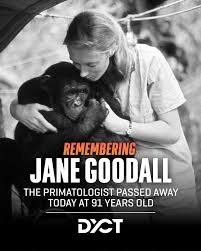
Ethologist, primatologist, conservationist, humanitarian, author, National Geographic Explorer—Jane Goodall captivated and inspired the world by recording unprecedented observations of chimpanzees, humans’ closest genetic relatives.
Jane Goodall Institute
ByDavid Quammen
December 1, 2025
Humans once stood on a pedestal: made by God in his image, earthly lords of all creation, categorically distinct from mere animals. That was the belief, anyway. Jane Goodall played a large role in eroding that self-flattering conviction, with her extraordinary study of wild chimpanzees at what is now Gombe National Park in Tanzania. By discovering unexpected behavioral similarities between chimps and humans, she continued the revolution begun by Copernicus and Galileo and advanced in a great leap by Charles Darwin: taking Earth out of the center of the universe and humans down from our holy isolation. Goodall helped us see, long before genome comparisons confirmed it, that the gap between chimps and people is smaller than anyone thought. Gorillas aren’t the closest living relatives of chimpanzees. We are.
She couldn’t live forever, though her impact will. Goodall’s life ended in October in Los Angeles, while she was on yet another speaking tour. Ever since 1986, when she chose to step away from her scientific role and become an activist, she had traveled, lectured to large crowds, made uncountable media appearances, called on political leaders, and met quietly with groups of children, all in an effort to change human hearts and human ideas—to bring people toward a gentler and more knowing relationship with the natural world. She was 91. In the days after her death, it was reported that she died of natural causes. That’s a vague phrase, carrying almost no meaning except that a person was old and that life is finite. It’s a little too negative. I think you could just as well say that she died of fulfillment.
Goodall began her work with chimpanzees in the 1960s in what is now Gombe National Park in Tanzania. As her career blossomed, she maintained a steady presence there, developing a multigenerational view of the animals, including Prof and Pax, pictured with Goodall in 1990. The pair were sons of a chimp…Read More
MICHAEL NICHOLS
National Geographic supplied Goodall with a camera in her early days at Gombe to document the chimpanzees. Some of the images she sent back are seen here, along with photos from cinematographer and first husband Hugo van Lawick.
HUGO VAN LAWICK
In the long lifetime between her birth and her death, one date is paramount. On July 14, 1960, at age 26, she arrived by boat at Gombe, on the east shore of Lake Tanganyika, in what is now Tanzania, to begin her study of chimpanzees. At that time, the total population of chimps—which are endemic to equatorial Africa—was roughly a million. A mere hundred or so lived in the Gombe reserve. But maybe they could be taken as representative.
She was an improbable fit for the task. She had no qualifications in biology, no academic degree. Money had been short after her parents’ divorce, and in lieu of university, Goodall got herself practical training at a secretarial school. But she had impractical dreams—of working with wildlife, or perhaps as a journalist—and ferocious strengths, identified first by the eminent paleoanthropologist Louis Leakey, who hired her as his secretary in Nairobi, Kenya. Over time, she impressed him. He saw something more, and he offered her a new challenge. He wanted some insights on chimpanzee ethology because he thought that might illuminate human ancestry.
The primary aim of my field study was to discover as much as possible about the way of life of the chimpanzee before it is too late—before encroachments of civilization crowd out, forever, all nonhuman competitors. Second, there is the hope that results of this research may help man in his search toward understanding himself. Laboratory tests have revealed a surprising amount of ‘insight’ in the chimpanzee—the rudiments of reasoned thinking. Knowledge of social traditions and culture of such an animal, studied under natural conditions, could throw new light on the growth and spread of early human cultures.
Jane Goodall, from “My Life Among Wild Chimpanzees,” August 1963 issue of National Geographic
“I didn’t even know what ethology was,” Goodall told me in 2010, one of many conversations we shared. “I had to wait quite a while before I realized it simply meant studying behavior.”
But when she arrived at Gombe, she was a keen and patient observer, and the chimps gradually grew to trust her. Their trust allowed her to witness behaviors previously unknown to science. Within just a few months she made three major discoveries: that chimps use tools, that chimps make tools, and that chimps can be formidable predators, hunting and killing other animals (such as monkeys) to satisfy their delectation of meat. At a time when physical anthropologists treated “man the toolmaker” as a canonical definition of Homo sapiens and the public viewed chimpanzees as benign circus-act fools, her findings resounded widely. Leakey bragged about her to scientific friends. In 1961 she got her first grant from the National Geographic Society.
One other revelation she offered, running contrary to the dry analytics and conventional wisdom of academic ethology, was that individual chimpanzees have unique personalities. She made some of them famous to the world: David Greybeard, the first chimp at Gombe that reciprocated her tentative outreach; Frodo, the bully; Flo, the greatest and most beloved matriarch ever at Gombe, according to Goodall. She described those personages and discoveries in the pages of this magazine, beginning in 1963, and the stories made her an international icon. The accompanying photographs of the beautiful young English woman befriending apes in an African forest helped too. In 1966, never mind having skipped an undergraduate degree, she received a Ph.D. in ethology from the University of Cambridge. In 1971 the book she wrote about her time at Gombe, In the Shadow of Man, became a global hit.
(Read Jane Goodall’s iconic 1963 tale of chimpanzees that still astonishes today.)